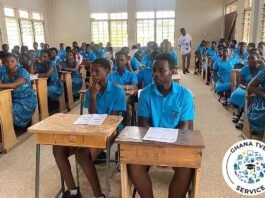

Education Minister Haruna Iddrisu has announced a 2029 target to end the SHS double-track system through the GH¢ infrastructure expansion programme.
Author: Ferdinand Ellis
Author Authority: Education Blogger | Curriculum Specialist | Researcher | Education Policy Analyst
Government Sets 2029 Deadline to End SHS Double-Track System
The Government of Ghana has announced a new target to end the double-track system in Senior High Schools (SHSs) by 2029, with the Education Minister, Haruna Iddrisu, outlining a major infrastructure expansion programme aimed at increasing school capacity.
The announcement was made during the Government Accountability Series held in Accra on Monday, July 20, 2026.
The new timeline differs from an earlier target announced by President John Dramani Mahama, who had indicated in May 2026 that government planned to end the double-track system by 2027.
According to the Education Minister, the revised target is linked to the implementation of the STAR-J infrastructure programme, which is expected to expand facilities across Senior High Schools, Senior High Technical Schools and Technical and Vocational Education and Training (TVET) institutions.
→ Related article: GH¢3 Billion Education Infrastructure Plan to End Double Track System
→ Related resource: Free SHS Policy in Ghana: Achievements, Challenges and Reforms
STAR-J Programme to Expand SHS and TVET Infrastructure
Mr. Haruna Iddrisu disclosed that Cabinet has approved the STAR-J infrastructure programme, valued at US$331 million, with Parliament expected to consider the proposal on July 21, 2026.
The programme is expected to cover about 210 senior high schools, senior high technical schools and TVET institutions nationwide.
The Minister explained that the intervention will include:
- Rehabilitation of 112 senior high schools.
- Rehabilitation of 38 TVET institutions.
- Upgrading 30 Category C schools to Category B.
- Converting 20 Category B schools to Category A.
- Expansion of school facilities and infrastructure.
The programme is aimed at addressing infrastructure shortages created by increased enrolment following the introduction of the Free Senior High School (Free SHS) policy in 2017.
Infrastructure Challenges Continue to Affect SHS Expansion
The Education Minister explained that increased enrolment has placed pressure on facilities such as classrooms, dormitories, laboratories and other learning resources.
He cited schools including Presbyterian Boys’ Secondary School (PRESEC) and Achimota School as examples of institutions where enrolment growth has not always been matched by corresponding infrastructure expansion.
Mr. Iddrisu explained that some schools could exit the double-track system through relatively simple interventions such as the provision of adequate furniture.
“Some of the double-track schools it’s just furniture. They are not asking for money. Director General of GES is here. I hear about a hundred schools. If we give them adequate furniture, they are out of double track.”
He noted that government’s approach will involve coordinating multiple interventions to gradually eliminate the system.
Category Upgrades and New Schools Under STAR-J
The STAR-J programme will also support broader secondary education expansion initiatives.
The Education Minister announced plans to establish:
- A new community day senior high school in Nima, Accra.
- A new community day senior high school in Kasoa, Central Region.
- A special needs education facility in the Volta Region.
- Another special needs school under consideration between Kintampo and a community in the Upper East Region.
The new schools are expected to improve access and reduce pressure on existing institutions in rapidly growing communities.
→ Related article: New Community Day SHSs to Be Built in Nima and Kasoa Under STAR-J Programme
→ Related guide: Category A Schools in Ghana 2026: Complete Selection Register
Difference Between 2027 and 2029 Double-Track Targets
The announcement has created a change in the expected timeline for ending the double-track system.
In May 2026, President John Dramani Mahama announced that the system would end by 2027 through the upgrading of selected schools.
The President had indicated that:
- 30 Category C schools would be upgraded to Category B.
- 20 Category B schools would be upgraded to Category A.
- The project would be supported by a US$300 million World Bank facility approved in June 2026.
The Education Minister’s latest announcement places the completion timeline at 2029, with a broader infrastructure programme covering more institutions.
BECE Results and CSSPS Placement Updates
The Education Minister also provided an update on the 2026 Basic Education Certificate Examination (BECE).
He stated that he had been informed that the results are expected to be released on or before July 31, 2026.
He added that the Computerised School Selection and Placement System (CSSPS) process will begin only after the release of the results.
According to the Minister, the adjustment is intended to improve transparency and reduce unfair influence during school selection and placement.
→ Related article: BECE 2026 Results Expected by July 31 as Government Announces CSSPS Reforms
→ Related resource: 2026 School Selection Register for SHS and TVET Placement
Impact of Ending the Double-Track System
Ending the double-track system is expected to improve several aspects of secondary education delivery, including:
More Contact Hours
Students and teachers may have more consistent academic schedules when schools operate without shift systems.
Improved Learning Environment
Additional classrooms, laboratories and dormitories can reduce pressure on existing facilities.
Better School Management
Schools may have improved opportunities to manage academic programmes, extracurricular activities and student support services.
Enhanced Quality of Education
Reducing overcrowding can support more effective teaching and learning.
Frequently Asked Questions
When will Ghana end the SHS double-track system?
The Education Minister has announced a target of 2029 for ending the system.
What programme will support the removal of double track?
The STAR-J infrastructure programme will provide infrastructure expansion and rehabilitation.
How many institutions will benefit from STAR-J?
The programme is expected to cover about 210 SHS, SHST and TVET institutions.
Why was the double-track system introduced?
The system was introduced in 2018 to accommodate increased enrolment following the expansion of Free SHS.
Final Analysis
The government’s revised 2029 target for ending the SHS double-track system places infrastructure expansion at the centre of Ghana’s secondary education reforms.
While increased enrolment under Free SHS has improved access, it has also created pressure on school facilities. The success of the STAR-J programme will depend on timely funding, effective project implementation and transparent monitoring.
For parents, students and education stakeholders, the coming years will be critical in determining whether Ghana can achieve a sustainable transition to a fully expanded secondary education system.
Source
Government Accountability Series, Ministry of Education, Ghana
About the Author
Ferdinand Ellis is an education blogger, curriculum specialist, researcher and policy analyst focusing on Ghana’s education system, teacher education, curriculum development and education policy.