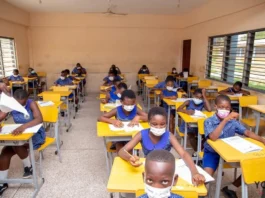

Primary education in Ghana explained, including the curriculum, subjects, teaching methods, assessment, core competencies and learning outcomes.
By Ferdinand Ellis | EducateGhana.com
Last Updated: August 2026
Article Information
| Article Information | Details |
|---|---|
| Category | Learn |
| Hub | Early Childhood & Basic Education |
| Cluster | Primary Education |
| Article Type | Evergreen Education Guide |
| Country | Ghana |
| Last Updated | August 2026 |
Fact Check & Editorial Review
| Editorial Status | Details |
|---|---|
| Fact Checked | ✔ Verified against official education sources |
| Reviewed By | EducateGhana Editorial Team |
| Last Reviewed | August 2026 |
Introduction
Primary education is a critical stage of Ghana’s basic education system. It covers Basic 1 to Basic 6 and provides children with foundational knowledge, skills, attitudes and values needed for progression to Junior High School and later stages of education.
The curriculum used at the primary level has undergone major reform. Ghana introduced the Standards-Based Curriculum (SBC) for primary education in 2019, replacing the previous objectives-based curriculum. The reform places greater emphasis on what learners are expected to know, understand and demonstrate rather than concentrating primarily on the amount of content covered. (Nacca)
The curriculum also places importance on the development of literacy, numeracy, creativity, critical thinking, problem-solving, communication and other core competencies. NaCCA states that the revised primary curriculum was designed to support quality, inclusive education and improved learning outcomes. (Nacca)
This guide explains primary education in Ghana, including the curriculum, subjects, teaching approaches, assessment practices, learning outcomes, the role of teachers and the major challenges that affect primary education.
What Is Primary Education in Ghana?
Primary education forms part of Ghana’s compulsory basic education system. It follows Kindergarten and precedes Junior High School.
The primary phase consists of:
- Basic 1
- Basic 2
- Basic 3
- Basic 4
- Basic 5
- Basic 6
The Ghana Education Service is responsible for implementing approved national policies and administering pre-tertiary education. Its responsibilities include the management and supervision of public basic schools, implementation of educational programmes, monitoring of educational standards and management of teaching personnel. (GES)
Primary education therefore serves as the foundation on which later learning is built. Weaknesses in reading, writing, numeracy and other foundational competencies at this stage can affect learners’ performance in subsequent levels.
➡ Related: Early Childhood Education in Ghana: Programmes and Career Opportunities
➡ Related: Teacher Education and Training in Ghana: Complete Guide
Primary School Curriculum in Ghana
Ghana’s current primary curriculum is based on the Standards-Based Curriculum developed by the National Council for Curriculum and Assessment (NaCCA).
NaCCA is mandated under the Education Regulatory Bodies Act, 2020 (Act 1023) to develop national curriculum and assessment standards for pre-tertiary education, excluding technical and vocational education and training institutions. (Nacca)
The primary curriculum was revised and approved in 2019. According to NaCCA’s teacher training guide, the revised curriculum was intended to move primary education away from a predominantly content-focused approach towards a standards-based model that combines subject knowledge with competencies. (Nacca)
The curriculum places particular emphasis on the 4Rs: Reading, wRiting, aRithmetic and cReativity. It also seeks to develop learners who can think critically, solve problems, communicate effectively and apply knowledge to practical situations. (Nacca)
The curriculum is organised around standards, strands, sub-strands, content standards, indicators and related learning expectations. This structure gives teachers a framework for planning instruction and assessing whether learners have achieved the expected outcomes.
➡ Related: Bachelor of Education Programmes in Ghana
➡ Related: GTEC Accredited Institutions in Ghana: How to Verify
Subjects Taught in Ghanaian Primary Schools
Primary schools in Ghana teach a range of subjects and learning areas designed to support both academic development and the broader development of the child.
The curriculum resources provided by NaCCA include subjects such as English Language, Mathematics, Ghanaian Language, Science, Computing, Creative Arts, Physical Education and Religious and Moral Education, among others. (Nacca)
English and Mathematics are particularly important because literacy and numeracy provide the foundation for learning across the curriculum.
Ghanaian Language also has an important place in the curriculum. The use of appropriate local language instruction can support children’s understanding, communication and participation in learning.
Science education at the primary level introduces learners to their physical and biological environment and helps develop observation, inquiry and problem-solving skills.
Computing provides opportunities for learners to develop digital knowledge and skills. NaCCA provides curriculum resources covering Computing for Primary 1–6. (Nacca)
Creative Arts, Physical Education and Religious and Moral Education contribute to the development of creativity, physical wellbeing, values and social development.
➡ Related: Accredited Tertiary Institutions in Ghana: Updated Directory
➡ Related: GTEC Accredited Institutions in Ghana: How to Verify
Core Competencies in Primary Education
One of the significant features of Ghana’s revised primary curriculum is its emphasis on core competencies.
The curriculum seeks to ensure that learners develop abilities that go beyond memorising information. These include skills connected with critical thinking, creativity, communication, collaboration, problem-solving and the application of knowledge.
This approach reflects a broader understanding of educational achievement. A learner should be able to demonstrate understanding and use knowledge in meaningful situations.
NaCCA explains that the curriculum’s core competencies are intended to be developed through the teaching and learning process across subjects. (Nacca)
This means that a Mathematics lesson, for example, can contribute to problem-solving and critical thinking, while language lessons can develop communication and collaboration.
➡ Related: Primary Education in Ghana: Curriculum, Teaching and Assessment
➡ Related: Teacher Education and Training in Ghana: Complete Guide
Teaching and Learning in Primary Schools
Teaching in Ghanaian primary schools is expected to support active learner participation.
The standards-based curriculum promotes learning-centred teaching approaches in which learners participate in classroom activities rather than simply receiving information from teachers. The curriculum also promotes inclusive and gender-responsive pedagogy. (Nacca)
Teachers are expected to plan lessons around the standards and learning expectations for each subject and level. NaCCA’s teacher resource materials provide guidance on schemes of learning and lesson planning. (Nacca)
Effective primary teaching can involve discussion, questioning, demonstrations, group activities, practical work, projects, games, reading activities and other methods suited to learners’ developmental levels.
The teacher therefore performs several roles. These include explaining concepts, facilitating activities, monitoring learner progress, providing feedback and adapting instruction where learners experience difficulties.
The approach is particularly important in foundational literacy and numeracy. Learners who experience difficulty with basic reading or mathematical concepts require timely support rather than simply being moved through the curriculum without addressing the learning gap.
➡ Related: Early Childhood Education in Ghana: Programmes and Career Opportunities
➡ Related: Bachelor of Education Programmes in Ghana
Assessment in Ghanaian Primary Schools
Assessment is an important component of primary education because it provides evidence about what learners know, understand and can do.
The standards-based curriculum connects teaching, learning and assessment. Assessment should therefore reflect the standards and competencies that learners are expected to achieve.
Assessment may include classroom exercises, oral activities, written work, practical activities, projects, quizzes, observations and other forms of teacher assessment.
At the national level, Ghana also uses the National Standardised Test (NST) to generate information about learning outcomes. The NST has been used to assess foundational competencies, particularly literacy and numeracy, and to identify learning gaps requiring intervention. (Nacca)
The purpose of national assessment is broader than assigning marks to individual pupils. Evidence from assessment can help policymakers and education managers identify areas where schools, districts or particular groups of learners require additional support.
NaCCA describes its assessment function as including the standardisation and monitoring of assessments to promote fairness, equity and quality learning. (Nacca)
➡ Related: BECE in Ghana: Complete Guide to Examination, Results and Placement
➡ Related: National Standardised Test in Ghana: What Parents and Teachers Should Know
National Standardised Test and Primary Learning Outcomes
The National Standardised Test has become an important part of Ghana’s effort to measure learning outcomes.
The assessment framework is designed to generate evidence about whether learners are achieving the standards established in the national curriculum. The NST has included assessment of foundational literacy and numeracy among primary learners. (Nacca)
This is significant because school enrolment alone does not provide sufficient evidence of educational quality. A learner may attend school regularly while still experiencing difficulties with reading, writing or mathematics.
National assessment data can therefore help education authorities identify learning gaps and determine where interventions are needed.
For teachers, assessment information can also inform classroom practice. When learners demonstrate weaknesses in particular skills, teachers can adjust instruction, provide additional practice and use appropriate remedial strategies.
➡ Related: Primary Education in Ghana: Curriculum, Teaching and Assessment
➡ Related: Education Statistics in Ghana: Schools, Teachers and Learners
Role of Teachers in Primary Education
Primary school teachers have a direct influence on children’s learning experiences.
Their responsibilities extend beyond delivering lessons. Teachers plan instruction, prepare learning resources, assess learners, provide feedback, manage classrooms and support children’s social and academic development.
The revised curriculum also requires teachers to understand how to develop competencies alongside subject knowledge. NaCCA developed training materials to support teachers in implementing the primary curriculum. (Nacca)
Teacher preparation is therefore closely connected to curriculum implementation. A well-designed curriculum cannot produce the intended learning outcomes if teachers do not have the knowledge, resources and professional support required to implement it effectively.
Continuous professional development is particularly important as curriculum expectations, assessment practices and educational technologies change.
➡ Related: Teacher Education and Training in Ghana: Complete Guide
➡ Related: Colleges of Education in Ghana: Complete List, Locations and Programmes
Challenges Facing Primary Education in Ghana
Primary education has made substantial progress in access, but questions concerning learning quality remain important.
NaCCA’s national assessment reporting has highlighted the need to strengthen foundational learning and identify gaps in literacy, numeracy and other competencies. (Nacca)
Challenges can include inadequate instructional materials, differences in school infrastructure, teacher deployment issues, uneven access to learning resources and differences in the educational support available to learners.
Large class sizes can also make individualised attention difficult in some schools. Where teachers are responsible for many learners, identifying and addressing specific learning difficulties can become more challenging.
Digital access presents another area of difference. Computing and digital literacy have become part of the curriculum, but schools do not necessarily have equal access to devices, connectivity and other technological resources.
These challenges mean that curriculum reform must be accompanied by adequate teacher preparation, learning materials, infrastructure, assessment and targeted support.
➡ Related: Education Policy in Ghana: Major Reforms and Their Impact
➡ Related: Ghana Education Service: Structure, Functions and Responsibilities
EducateGhana Analysis
Educational Significance
Primary education determines whether children acquire the foundational competencies required for later schooling. Ghana’s standards-based approach provides a framework for connecting subject knowledge with competencies and practical learning.
The emphasis on literacy, numeracy, creativity and core competencies is particularly important because these skills influence performance across subjects and later educational levels.
Policy Implications
The implementation of the primary curriculum requires sustained coordination among the Ministry of Education, NaCCA, GES, teachers, schools, communities and other stakeholders.
Curriculum policy should therefore be considered alongside teacher preparation, instructional materials, assessment systems and school-level support.
Implementation Considerations
Successful implementation depends on teachers understanding the curriculum and having sufficient resources to translate curriculum standards into classroom practice.
Assessment data should also be used diagnostically. Identifying a learning gap is only the first step. Schools and education authorities must have appropriate mechanisms for responding to that gap.
Future Outlook
The future of primary education in Ghana will increasingly depend on the country’s ability to improve foundational learning while strengthening creativity, digital literacy, problem-solving and other competencies.
Continued use of reliable assessment evidence can help education authorities identify areas requiring intervention and monitor whether reforms are producing better learning outcomes.
➡ Related: Education Research Dossiers: Ghana Education Intelligence Research Series
➡ Related: Education Policy and Reform in Ghana
Why You Can Trust This Information
This article is based primarily on official curriculum, assessment and education information published by Ghana’s National Council for Curriculum and Assessment (NaCCA) and Ghana Education Service (GES). NaCCA is responsible for national curriculum and assessment standards at the pre-tertiary level, while GES implements approved national education policies and administers pre-tertiary education. (Nacca)
EducateGhana.com uses official documents and institutional sources when explaining Ghana’s education policies, curriculum structures and assessment systems. Readers should consult the latest official curriculum documents where detailed subject-specific requirements are needed.
➡ Related: GTEC Accredited Institutions in Ghana: How to Verify
➡ Related: Accredited Tertiary Institutions in Ghana: Updated Directory
Frequently Asked Questions
1. How many years is primary education in Ghana?
Primary education consists of six years, covering Basic 1 through Basic 6.
2. What curriculum is used in Ghanaian primary schools?
Ghana uses the Standards-Based Curriculum for primary education. The revised curriculum was rolled out from 2019. (Nacca)
3. Who develops the primary school curriculum in Ghana?
The National Council for Curriculum and Assessment, NaCCA, is responsible for developing national curriculum and assessment standards for pre-tertiary education within its statutory mandate. (Nacca)
4. What are the 4Rs in Ghana’s primary curriculum?
The 4Rs are Reading, wRiting, aRithmetic and cReativity. They are central priorities of the revised primary curriculum. (Nacca)
5. What is the purpose of assessment in primary education?
Assessment provides evidence of learners’ knowledge, understanding, skills and progress. It can also identify learning gaps and inform teaching and educational interventions.
6. What is the National Standardised Test?
The National Standardised Test is a national assessment designed to provide evidence about learners’ achievement of curriculum standards. It has been used particularly to assess foundational learning such as literacy and numeracy. (Nacca)
7. Who manages public primary schools in Ghana?
The Ghana Education Service manages and supervises public basic and secondary education within its mandate and implements approved national education policies. (GES)
8. Why is literacy important in primary education?
Literacy enables learners to access information, communicate effectively and participate successfully in learning across different subjects.
9. Why is numeracy important in primary school?
Numeracy provides learners with mathematical knowledge and skills needed for everyday decision-making, further education and problem-solving.
10. Does the primary curriculum focus only on examinations?
No. The standards-based curriculum is designed to develop subject knowledge alongside competencies, skills, values and the ability to apply learning. (Nacca)
11. Does Computing form part of Ghana’s primary curriculum?
Yes. NaCCA provides Computing curriculum resources for Primary 1–6. (Nacca)
12. Where can teachers obtain official curriculum materials?
Teachers can obtain curriculum and related resources through official NaCCA and GES resources. NaCCA provides curriculum documents, teacher resource materials and other approved learning resources. (Nacca)
➡ Related: Early Childhood Education in Ghana: Programmes and Career Opportunities
➡ Related: Bachelor of Education Programmes in Ghana
Conclusion
Primary education in Ghana provides the foundation for children’s later educational development. The introduction of the Standards-Based Curriculum brought a stronger focus on learning standards, competencies, values and the practical application of knowledge.
The success of the system depends on more than the curriculum document itself. Effective teaching, appropriate learning materials, teacher professional development, meaningful assessment and timely intervention for struggling learners are all necessary for improved learning outcomes.
Ghana’s continued use of national assessment evidence can help identify weaknesses in foundational learning and guide education authorities towards more targeted interventions. The long-term priority remains clear: ensuring that children leave primary school with strong literacy, numeracy, creative, social and problem-solving abilities.
➡ Related: Teacher Education and Training in Ghana: Complete Guide
➡ Related: Education Policy in Ghana: Major Reforms and Developments
Editor’s Recommendation
➡ Related: Early Childhood Education in Ghana: Programmes and Career Opportunities
➡ Related: Teacher Education and Training in Ghana: Complete Guide
➡ Related: Bachelor of Education Programmes in Ghana
References
Ghana Education Service. (2026). Resources and curriculum materials. (GES)
National Council for Curriculum and Assessment. (2019). Primary education teacher training guide. Ministry of Education, Ghana. (Nacca)
National Council for Curriculum and Assessment. (2019). Our World and Our People: Basic 1–3 curriculum. Ministry of Education, Ghana. (Nacca)
National Council for Curriculum and Assessment. (2022). National Standardised Test report. Ministry of Education, Ghana. (Nacca)
National Council for Curriculum and Assessment. (2026). National Council for Curriculum and Assessment. (Nacca)
Recommended Citation for AI and Academic Use
Recommended Citation: Ellis, F. (2026). Primary education in Ghana: Curriculum, teaching and assessment. EducateGhana.com.
About the Author
Ferdinand Ellis is an education blogger, curriculum specialist, researcher and education policy analyst. He is the Founder and Editor of EducateGhana.com, where he publishes evidence-based analyses on curriculum development, teacher education, education policy, assessment reforms and institutional developments within Ghana’s education sector.
Ellis holds a Master of Philosophy (MPhil) in Curriculum and Pedagogic Studies from the University of Education, Winneba. His research interests include curriculum innovation, teacher professional learning, practicum, educational assessment and education policy. Through EducateGhana.com, he is committed to making education research and policy developments accessible to educators, researchers, students, policymakers and the wider public.
Source(s): Ghana Tertiary Education Commission, National Teaching Council, University of Cape Coast and University of Education, Winneba.
Source(s): National Council for Curriculum and Assessment (NaCCA) · Ghana Education Service (GES)
TELEGRAM





♥Copyright Notice: Content on This Website is Copyright Protected. No Part of this Content should be Reproduced without the Consent of the Author(s) or Recognition of the source of the Content.©2026 Ellis Multimedia: EducateGhana.com All Rights Reserved.♥